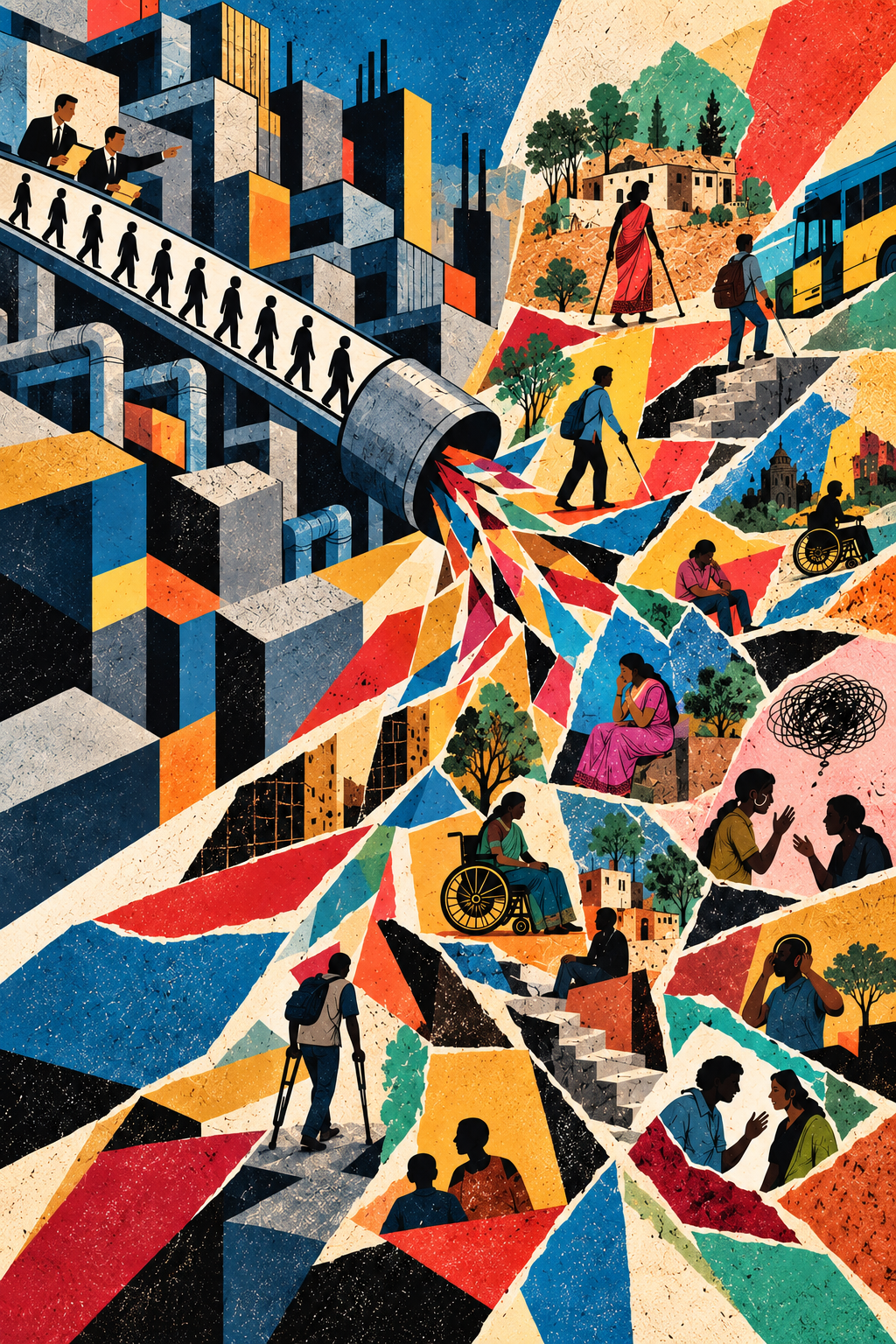
Every conversation I have with public policy and CSR professionals eventually comes back to scale. How many people can you reach? How fast can you grow? How many beneficiaries can you show in your report? If you can answer these questions with convincing numbers, funding becomes easier.
India’s disability sector receives about 0.9% of total Corporate Social Responsibility (CSR) funding. For 2026–27, the dedicated disability budget stands at 0.0312% of total government expenditure, allocated through the Department of Persons with Disabilities under the Ministry of Social Justice and Empowerment.
I have always believed that disability is a policy problem that cuts across sectors, not a separate charity box that organizations and governments can tick. But the more I think about this, the more I wonder whether we are even prepared to understand what this means on the ground.
In a village or a tier-3 city, disability inclusion and accessibility are often unfamiliar terms. Sometimes, they are little more than welfare jargon used in proposals and presentations. We talk about mainstreaming disability, but the people we are talking about are not even part of the conversation.
I think the problem begins with how we understand scale.
Funding tends to flow towards healthcare, education, and livelihood programs because their outcomes are relatively easy to count. You can report how many people received treatment, enrolled in school, or completed a training program. But disability does not fit neatly into these categories, at least not in the way most programs are designed.
The only formal framework that brings all the disabilities under a common umbrella is the Rights of Persons with Disabilities (RPwD) Act, 2016, which recognizes 21 specified disabilities.
At the policy level, reaching scale is imperative; that’s why grouping all kinds of disability makes sense, since that number represents a sizable population in the country.
On population, the census process is ongoing, but disability data are collected very differently. The RPwD Act mentions 21 types of disability, but to streamline the process, they have been grouped into 9 broad categories. Disability activists argue that these 9 categories do not fully capture all disabilities, but in practice, enumerators at the grassroots are rarely adequately trained or equipped to document their true diversity.
Consider the women’s self-help group movement in rural India. Forty years ago, getting women to participate in economic activities outside their homes was a struggle in many places. It took years of groundwork, community mobilization, and institutional support to build the movement we see today. Women from different castes and backgrounds had their own differences and hierarchies, but the intervention could still find common ground to organize around. Also, retaining women-only groups helped with security and incentivized women to open up in a rural setting where patriarchy is deeply entrenched.
Disability presents a different challenge. A person with a visual impairment may need accessible learning materials and assistive technology. A person with a locomotor disability may need accessible transport, buildings and toilets. A person with a hearing impairment needs sign language interpretation and communication support. There may be overlap, but the support required can differ greatly. A lack of common lived experience also plays a part. This difference is very visible in how batches of people with disabilities are formed in training workshops, where one type of disability predominates. A cross-disability perspective seems desirable at the conceptual level, but grassroots resource mobilization and technology remain lacking.
We rarely account for these differences when designing programs. We bring people under the same category of disability and assume that a common intervention will work for everyone.
This problem also shows up in local Disabled People’s Organizations (DPOs). Many organizations have historically developed around specific disabilities. Visually impaired groups have organized around Braille and access to information, deaf groups around sign language and communication, and groups of people with locomotor disabilities around ramps, transport and mobility.
In rural districts, the people leading local DPOs are often those with locomotor disabilities. This is not necessarily because they are more capable or more committed than others. They may simply have fewer communication barriers when making calls, meeting officials or approaching institutions. Bringing people with different disabilities together requires resources, exposure, and support that local organizations may not have.
I saw some of these challenges while working on a skill development workshop in Deoghar, Jharkhand.
Our intention was to bring together people with different disabilities, with an equal representation of men and women. We worked with the local DPO to identify participants. But the local Rural Self Employment Training Institute (RSETI) required at least 25 participants to approve the training room and the batch. Otherwise, we couldn’t run the batch.
We had to meet the requirement. So we did.
Twenty-five people turned up. Twenty-three were men, and only two were women. Twenty-two participants had locomotor disabilities, although none used wheelchairs. Two were visually impaired, and one had a hearing impairment.
On paper, we had our batch. In reality, we had barely thought through what it would take to conduct the training.
The RSETI building was inaccessible. The steep steps, slippery floors, and poor toilet facilities made even routine activities difficult for participants with mobility issues. The two visually impaired participants could not access the printed handouts, and we had not arranged screen readers or alternative formats. The participant with a hearing impairment sat through sessions where communication was a constant problem because nobody knew sign language.
These were not unexpected needs. We simply had not planned for them.
Our budget had a fixed cost per participant. It did not adequately account for accessible transport, suitable accommodation, adapted learning materials, or the additional support required during the training. We counted each person as one beneficiary, but the resources needed to ensure their participation varied.
The trainers had never worked with persons with disabilities before. They weren’t sure how to communicate with participants, explain visual material, or make the sessions accessible. After struggling through the first morning, they gradually concentrated on the participants they could communicate with most easily. The others were left behind.
We had another assumption to confront. We thought that bringing people with disabilities together would somehow encourage them to support one another. That did not happen automatically. A person with a locomotor disability does not necessarily know how to guide someone with a visual impairment. Someone who can hear may not know how to communicate with a person with hearing impairment.
Many participants grew up with limited opportunities to interact with people outside their immediate social circles. They also hadn’t necessarily been given the opportunity to learn about other disabilities. We eventually had to pause the training and help participants communicate with one another.
The gender imbalance was another reminder of how poorly we had planned for the realities of inclusion.
Getting a woman with a disability to attend a residential training program in a place like Deoghar is not simply a matter of identifying her and sending an invitation. It may mean convincing parents worried about her safety, ensuring accessible accommodation and toilets, arranging transport, and making repeated visits before they agree.
This takes time. Sometimes, it takes weeks to build the trust required for a woman to participate.
But when the institution tells you that you need 25 participants by Monday, you are under pressure to find people who can attend immediately. You end up recruiting those who are easiest to reach rather than those who have been excluded the longest.
We met the target. RSETI got its 25 participants, submitted the batch report, and met the monitoring requirements.
But what had we actually achieved?
Months of field visits, coordination, and daily troubleshooting kept the training running. In the end, perhaps only one or two participants found a sustainable livelihood. When the program was reviewed, the conclusion was likely that it required too much effort for too little return and couldn’t be scaled.
The program could then be quietly discontinued.
This is what troubles me about the way we evaluate disability interventions. We often judge a program by its outcomes without examining the conditions under which it was implemented. A model built around fixed costs, inaccessible infrastructure, and a minimum beneficiary count is almost bound to struggle when faced with the real requirements of inclusion. Yet people attribute the failure to the intervention rather than the assumptions behind it.
I also kept thinking about something else after that training.
The twenty-five participants in the room had little in common in terms of their support needs. Legally, these 25 people had only one thing in common: their shared categorization under the RPwD Act. The law provides a common basis for rights and entitlements, but that does not mean people across these groups have the same experiences or can access the same opportunities through a common program.
Even the participants who made it to the training represented only a small section of the disability community.
The twenty-two participants with locomotor disabilities could walk without wheelchairs. People with high support needs, multiple disabilities, severe cerebral palsy, or complex intellectual disabilities were largely absent from this picture. In many villages and smaller towns, inaccessible buildings, limited educational opportunities, transport barriers, and family concerns can keep people from leaving home or participating in community activities.
They often go unnoticed in our programs before the question of livelihood or employment even arises.
This is an uncomfortable reality. The people we include most easily in a program can gradually become the people our programs are designed for. Those who need more support remain invisible, and their absence makes the program look more successful than it might actually be.
I do not think the answer is to stop thinking about scale. The disability sector needs more funding, stronger institutions, and interventions that can reach people beyond a handful of locations. But we need to ask what exactly we are scaling, and at whose expense.
My experience in Deoghar made me realize the problem wasn’t simply a lack of effort by the field team or a lack of willingness among participants. We tried to make inclusion work within a system not designed for it. We were expected to accommodate different needs using a budget that treated everyone as if they needed the same things. We were also expected to produce results within a timeline that left little room to build trust or prepare the institution.
This is where universal design becomes important. I had the opportunity to explore the concept both theoretically as a master’s student at TISS and practically through the Yes to Access Project in Bengaluru.
At TISS, my interactions with both peers and academia made me realize the importance of cross-experiential learning. What does it mean in reality? No human experience exists in isolation.
If buildings, training materials, communication systems, and curricula are designed from the start to accommodate a wide range of needs, everyone can participate more easily. It does not eliminate the need for individual accommodations or additional support, but it reduces reliance on last-minute arrangements.
In the Yes to Access Project, the focus was on scaling the Accessibility solution through an accessibility assessing app for public buildings, which moved beyond disability as envisioned in Universal Design. But the challenge was aligning diverse communities to recognize accessibility as a common issue.
That also means changing how CSR programs and government schemes are funded. Accessibility cannot be an added expense that field teams are expected to manage after the proposal is approved. We must recognize that identifying participants, building family trust, training staff, and arranging appropriate support are part of the intervention itself.
At the end of programs, we get impressive individual case studies, but as a collective, we fail to scale impact.
Otherwise, we will keep producing programs that look successful in reports but leave out the people who need them most.
Perhaps the more important question is not how quickly we can scale a disability intervention. It is whether the intervention is designed well enough to include people who are usually missing from the room.
Until we can answer that, our numbers may tell us how many people we reached. They will tell us very little about who we failed to reach, or why.


Leave a Reply