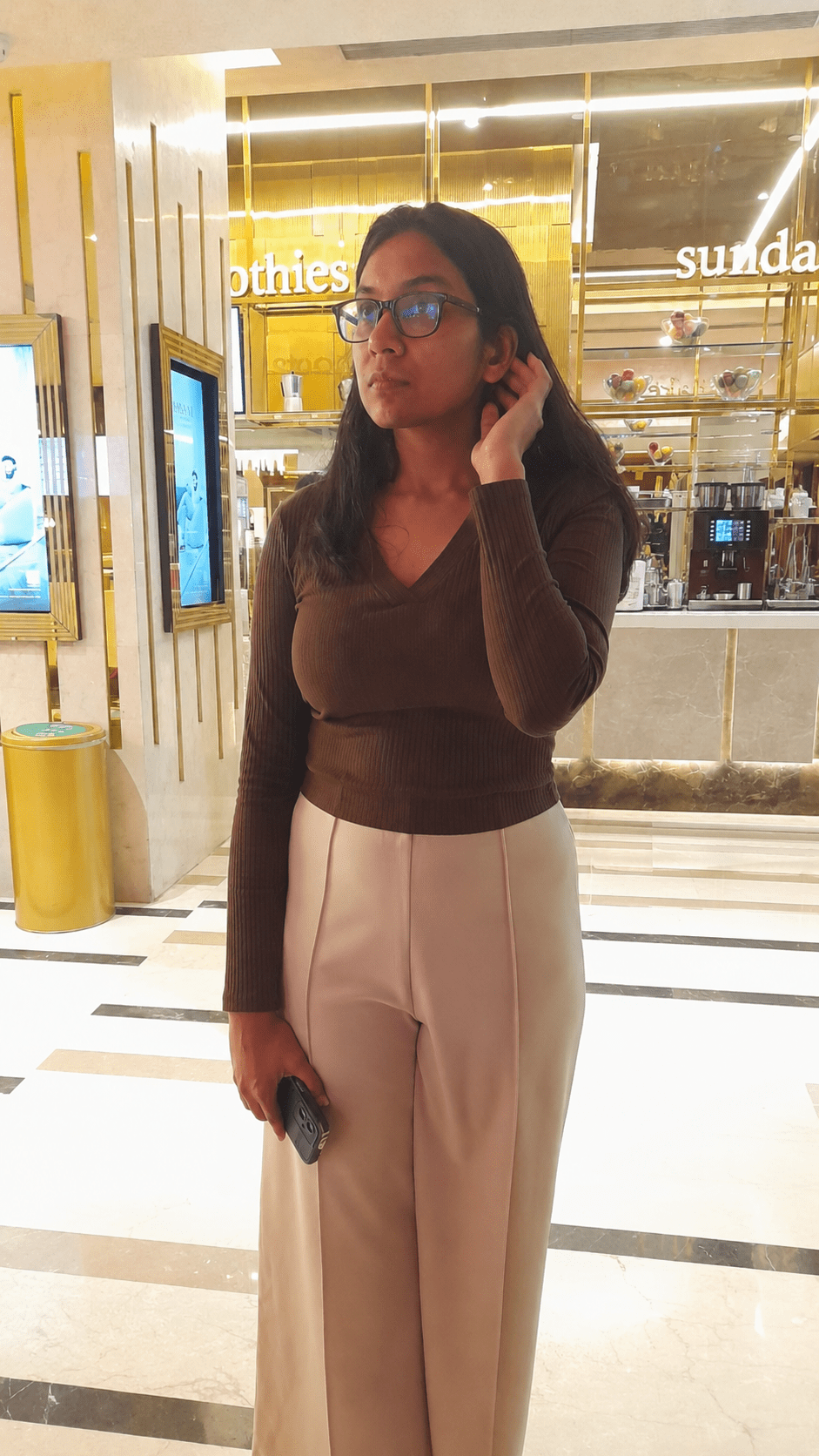
Introduction to the Author
Shruti Bhartia is a data analyst working at the intersection of risk, accessibility, and inclusive design. Visually impaired herself, she brings a unique blend of lived experience and technical expertise to her work—combining curiosity, precision, and a deep commitment to equitable outcomes. Whether navigating models, teams, or cities, Shruti focuses on asking strong questions and building data-driven tools that reflect real-world complexity. She is passionate about creating inclusive workspaces and continues to explore how analytics can be both rigorous and human-centered.
Writeup
Just Get a Government Job! The Advice Every Blind Person Is Tired of Hearing.
If I had a rupee every time someone told me, “Why don’t you just prepare for a government job?”, I probably wouldn’t need a government job anymore. It is perhaps India’s favourite solution to every problem faced by a person with visual impairment. Somewhere there exists an unwritten rule that blindness comes with exactly one acceptable career option.
The irony is that this advice usually comes from people who have never appeared for a government examination themselves. They have never navigated disability reservation rules, searched for a scribe, dealt with examination centres interpreting guidelines differently, or spent years preparing for competitive examinations. Yet they prescribe “government job” with the confidence of someone who personally drafted the recruitment policy.
Of course, government jobs offer dignity, stability, and meaningful careers for thousands of people, including many highly competent visually impaired professionals. But is government employment the only respectable ambition for a person with a disability? Is inclusion and accessibility something only the government can solve? Can only the government share meeting materials a few hours before the meeting? Have they attained a PhD in describing PowerPoint slides? Or does everyone in the government sector get client-facing opportunities? Accessibility requires effort. Advice is free.
People often imagine that government recruitment is somehow easier for persons with disabilities. However, the reality is very different. Reservation does create an opportunity to compete. It does not guarantee selection. Today’s government examinations are intensely competitive. Better study material, digital accessibility, and online learning have enabled more visually impaired students than ever before to prepare for these examinations. That is a welcome change. Unfortunately, vacancies have not increased at the same pace.
And then comes perhaps the most overlooked challenge of all—the scribe. For most examinations, finding a scribe is entirely the candidate’s responsibility. Very often, the eligibility rules of the scribe make this already daunting task impossible. There are different rules for different exams. Occasionally, the eligibility rules guarantee the scribe would never even be able to articulate the question on the paper appropriately. Apart from this, the accommodation, travel, and food of the scribe need to be taken care of by the candidate. And despite all this, something may easily go off on the morning of the examination. Sometimes it genuinely feels as though organising the scribe requires more planning than preparing for the examination itself.
When we request help in writing our papers, we are asked to hire scribes for amounts “as low as 1,500 a paper”. For many middle-class and lower-income families, that is not a minor inconvenience. It is a significant financial barrier. Here we see how accessibility, instead of reducing inequality, creates another expense.
On one hand, getting a scribe is very difficult, and on the other, being a scribe has emerged as the most profitable business. If one has the means, one does not even need to study for the exam. For an amount starting at half a lakh of rupees, the scribe writes the exam for you. Sometimes, these scribes find you even if you don’t want to find them. They feed on the candidate’s nervousness and the thousand rejections he or she has faced to tell them how diagrams, or speed, or something may fail them.
When examinations become dependent on the capability of the person sitting beside the candidate rather than the candidate themselves, merit inevitably suffers. And because disability vacancies are limited, even a few artificially high scores can raise cut-offs, pushing honest candidates out of selection. It is the deserving candidate who prepared honestly who is the biggest casualty in these cases. Some candidates come from affluent urban families with access to coaching, technology, and professional networks. These are the candidates who can afford such scribes. When these candidates use such scribes, inequality compounds. Reservation was created to reduce inequality, and it ends up rewarding those who already possess significant social and economic advantages.
However, hope is not all dead. The Staff Selection Commission has begun strengthening scribe verification and moving towards certified pools of scribes. Some examination authorities have recognised that the existing system requires reform. Even more encouraging is Karnataka’s initiative allowing visually impaired students to use laptops in certain public examinations instead of relying entirely on scribes.
To me, this is the future. After all, once recruited, a visually impaired employee is expected to work independently using screen readers such as JAWS or NVDA—not with a scribe sitting beside them. Technology can reduce cost, dependence, and the opportunity to misuse all at once. Most importantly, it allows the examination to test the candidate rather than the scribe.
There is one final point I wish people understood. Every individual, irrespective of disability, deserves the freedom to choose a career based on interest—not on society’s assumptions. Some people genuinely dream of government service. Others dream of becoming economists, entrepreneurs, researchers, lawyers, consultants, artists, or scientists. All of these aspirations are equally valid. The disability rights movement was never about funnelling everyone towards the safest career. It was about expanding choices.
Perhaps the next time a visually impaired professional faces a challenge, instead of asking, “Why don’t you just prepare for a government job?”, we should ask a better question: “What barriers are preventing you from pursuing the career you actually want?”
Because real inclusion is not achieved when every blind person gets a government job. It is achieved when every blind person has the freedom to choose any career—and a system that allows them to compete fairly for it.


 Project Samajh
Leave a comment