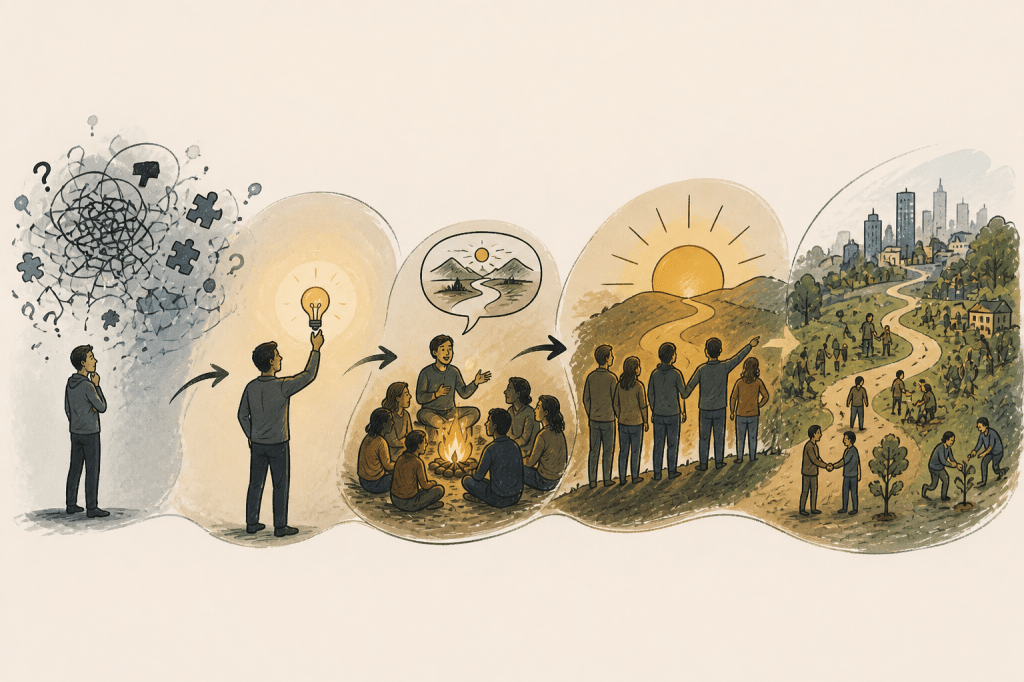
There are different kinds of boundaries on us that keep us away from our authentic selves. Society has built several structural barriers at various stages of life and at various levels to keep the individuality suppressed to achieve common goals, which is validated by the selected group of elite people who are at the top of decision-making in various fields. These structures aren’t necessarily bad for individual creativity, and most of the time, they only motivate individuals to work for a larger community. But it comes with its trade-off of individual autonomy. Initial upliftment, which seems like financial independence, becomes dependence on larger systems for stability rather than building something of their own, which entails risk-taking.
As individuals, we desire, somewhere down the line, ownership of our narrative and a higher purpose that drives us further. Most of us find value in a community with whom we share our common values and aspirations.
Traditionally, those common values and aspirations in society have been aligned by religious groups that seek a shared worldview, aiming to provide answers to life’s complex uncertainties and the changing dynamics of society.
But this approach doesn’t work for individuals who do not conform to predefined structures or answers. The primary causes include discrimination, conflict in worldview, and certain socioeconomic and physical barriers. Each form of barrier has its nuances that need to be understood to fully grasp the root of deviant thought.
Religion is one the major way of segmentation and organisation of society, but there are many ways of organising society.
These can on the basis social indicators such as class, caste and economic status and physical attributes.
In my own experience, my deviant thought arose because of loneliness, away from people who strived in the standard course of affairs, determined by societal structure. My disability played its part, but that’s not it. I have my share of privileges, but I could gaze something deeper.
People make you the star and the most valued thing when you act according to society’s metrics of success, but as soon as you deviate and start questioning their value system, they start getting uncomfortable, and slowly and steadily begin isolating you. They begin distancing themselves from you. Initially, it may look like something is wrong with you. They make you doubt yourself. But deep down there, they are scared by your presence. Your deviant thoughts and disagreements endanger their pretence and double standards.
This is where the detachment starts, and you start seeing the hypocrisy.
They love the defiant art, but not the cause of it. They love reading about discrimination and calling out the societal biases, but their own biases and perpetuated discrimination are invisible to them. They want to be seen on the right side with their symbolic gesture, but cannot make amends for their behaviour. They only desire validation. They surround themselves with people who can agree with them to create a sense of ease and normalcy.
Now the separation is complete. You cannot go back.


