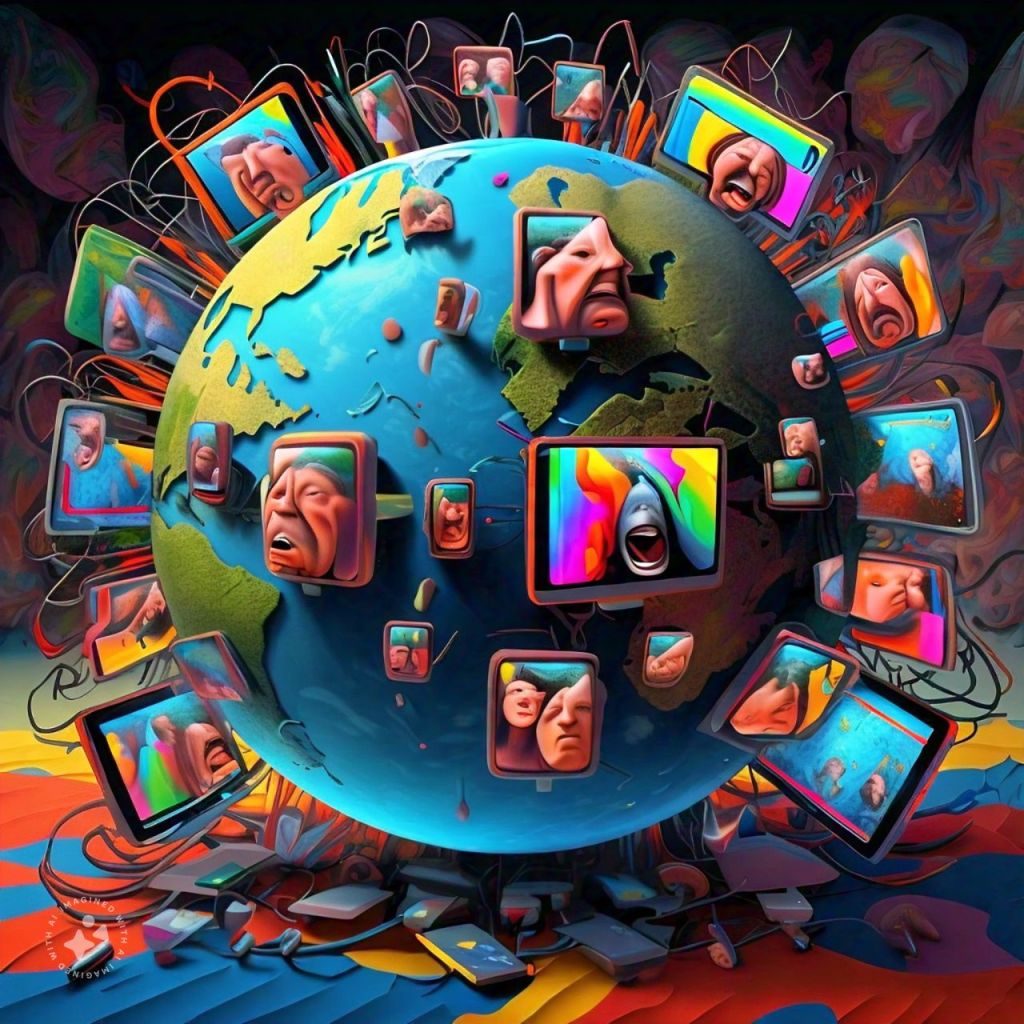
Image Description- AI generated representative image of delusional world in the world of incessant social media intoxication with human-like faces outraging in front of screens from various parts of the globe
A small story
As a kid, I had a deep desire to explore the world. Traveling to different places sparked my curiosity, fueling a hunger to know more. Back then, getting books was a struggle. I had to work hard, often quarreling with my father for them. Sometimes, those quarrels ended with me getting beaten up. Yet, every time I managed to get a book, it felt like I had truly earned it.
I devoured those books, always hungry for more knowledge. But now, with technology, every book, and every piece of information is just a click away, readily accessible at my fingertips. I spend my own money on them, yet it doesn’t feel the same. It no longer feels earned. Technology is indeed remarkable, but the moment it makes anything too easy, too unearned, it begins to strip away a part of what makes us human.
The Double-Edged Sword of Social Media Algorithms
The Internet, the way we see it now, entering our daily lives and extracting every detail of our lives without our consent, was not the way we imagined it to be when it started sprawling, and the Internet we witness today could not have been the same without social media. I remember the days of Orkut, the OG social network site when we sneaked from our house to the cyber cafe to connect with people online and chat. It was a thing to cherish and felt adventurous and niche. The cell phones and the smartphones were distant dreams. An hour of internet surfing used to cost Rs 10-20 bucks, which curtailed our usage, therefore the focus was to use it optimally. How social media and its algorithms operate today compels us to question how we can escape its trappings. There seems to be unlimited access penetrating into second-tier and third-tier cities These platforms seem to manipulate our brain functions by controlling dopamine spikes—a reality most of us recognize but struggle to address. Layered atop this manipulation is the attention economy, which monetizes absurdities that grab eyeballs with alarming efficiency. The Internet and social media in the name of customized tailored content take the agency away from the users to explore new topics. In the old times, when algorithms weren’t that efficient, we used to stumble upon new topics out of nowhere.
A New Era of Access, with New Hegemons
Social media has undoubtedly democratized access to opinions and views, dismantling the dominance of legacy media in shaping knowledge and information. However, gradually it gave rise to new hegemons—tech giants like Meta, Google, and X—that wield unprecedented control. These platforms collect vast amounts of user data, tracking preferences, choices, locations, likes, and dislikes. Armed with this data, they deploy increasingly aggressive algorithms designed to curate personalized feeds, ultimately aimed at maximizing views and attracting advertisers.
Initially, these platforms were presented as paragons of free speech, interconnectivity, and neutral grounds for open expression. They challenged traditional media, reshaping the media landscape to the extent that even legacy outlets had to join social media to remain relevant. Yet, this shift came with a catch: as social media became the primary source of information and entertainment, it revealed a Pandora’s box of ethical, social, and regulatory dilemmas. Since the whole enterprise of social networking sites was based on free membership and increased community engagement, it provided a platform to advertisers that became an important source of revenue for hosting sites that incentivized the sites to focus on the activity of users and gradually made the algorithm more aggressive.
Information Overload: The Naive View
Yuval Noah Harari, in his recent book Nexus: A Brief History of Information, critiques the “naive view” of information—an assumption that wholesale access to information would automatically yield wisdom or power which is the go-to trope for tech billionaires. Reality has proven otherwise. People have a basic instinct to be attracted by extremes if not trained properly, i.e., humans are basically driven by emotions rather than facts which enables the algorithm to exploit this human trait to increase engagement. Instead of fostering mutual respect and open discussion, the unrestricted flow of information has deepened hierarchies and created echo chambers.
However there are several fact-checker websites that emerged to counter the biases and fake news, but over time every ech0 chamber had its version of a worldview that would fact check from their perspective while avoiding or omitting the facts which would go against them
The Attention Economy and Short-Form Content
The attention economy, while democratizing social media content for wider audiences, has also strengthened short-form content as the dominant format. The algorithms driving these platforms are optimized to promote short-form videos, which align with the consumption habits of users seeking quick, bite-sized information.
For many, this format is appealing because it requires minimal time and financial investment. However, the underlying algorithms ensure that platforms continuously recommend similar content, keeping users engaged—and addicted.
On the flip side, this dynamic has created opportunities for creators with limited resources. The algorithm-driven preference for short-form content has enabled low-budget creators to gain recognition, financial upliftment, and a share of advertisement revenue. This level playing field has particularly benefited individuals from lower socio-economic backgrounds, who can now reach global audiences without significant financial backing. The people sometimes denigrate their content, social background, and appearance, which is reprehensible and counterproductive
Yet, the emphasis on engagement also incentivizes sensationalism, drawing users toward content that prioritizes instant gratification—a shock-and-awe effect that delivers a dopamine hit. The same algorithms that empower creators often trap users in conformist feedback loops, promoting content that reinforces existing biases.
Data Privacy in the Spotlight
The commercialization of social media has ushered in a troubling era of data exploitation. Users’ day-to-day activities are meticulously tracked, often without explicit consent. While this should be a concern for many, the dopamine-driven engagement offered by these platforms often overshadows privacy considerations.
The “Cringe” Economy
The attention economy has also given rise to a wave of “cringe creators” who exploit the human psyche’s tendency to react to absurdities. These creators deliver absurd content that appeals to viewers by offering a mix of shock and curiosity. While this phenomenon is not inherently negative, it raises important questions about the health implications of consuming such content.
This trend highlights the delicate interplay between innate human tendencies and algorithmic strategies designed to captivate. Although some may dismiss this content publicly, its widespread appeal suggests a deeper connection to the human psyche.
The Need for Transparency and Regulation
As social media platforms continue to penetrate new demographics and shape narratives in media and politics, the urgency for transparency becomes apparent. Harari argues that censorship is not the solution. Instead, the focus should be on holding tech giants accountable for the societal consequences of their algorithms.
Governments and companies are beginning to respond with legislation and regulations to address these issues. The digital battleground of political narratives calls for informed policy interventions that balance the protection of free speech with the enforcement of accountability.
Conclusion
The evolution of social media has brought both profound benefits and significant challenges. While it has democratized access to content creation and empowered marginalized voices, it has also entrenched echo chambers, exploited user data, and fostered sensationalist trends. Addressing these issues requires a concerted effort to implement transparent policies, foster ethical algorithm design, and educate users about the implications of social media consumption. Only through such measures can we navigate the complexities of the digital age and harness the true potential of social media for the collective good.
Last but certainly not least, it is not the question of policies and technologies, but the larger evolution of human civilization where we can think of the future where we can strike a balance between digital world and the natural world, between human independence and information overload.


 Project Samajh
Leave a comment